

Carbon Capture Technology Pricing: Industrial System Costs, Features & ROI Breakdown
November 7, 2026 | by Steve Last

Carbon capture technology pricing is hard to pin down when the quotes and headlines you have seen do not match. For the full chain of capture, transport and storage, expect about $20 to $150 per tonne of CO2, with a weighted average of $58. The National Audit Office (NAO) July 2024 report put the cost of the first UK funded projects at about £300 per tonne, if only those projects are supported.
On payback, carbon-price savings alone may not cover full-chain costs, so your return depends on whether you can win contracted support. This guide splits capture-only cost from full-chain cost and gives you a formula for a per-tonne price. It also sets out a quote checklist and a simple cash-flow test. Every figure keeps its own currency, so dollars and pounds are never mixed.
Key Takeaways
- Capture-only cost depends on the source. Gas processing can be under $25 per tonne, while steel and cement can go up to $75 to $100 per tonne.
- Full-chain cost, which adds transport and storage, runs from $20 to $150 per tonne, with a weighted average of $58.
- Storage is not a fixed add-on. Rystad Energy puts Gulf transport and storage in depleted fields at $15 to $40 per tonne, and European storage in saline aquifers at $40 to $50 per tonne.
- A per-tonne price is lifetime cost divided by lifetime CO2 on a stated basis, either avoided or captured.
- The NAO’s figure of about £300 per tonne was roughly eight times the UK carbon price when it reported in July 2024. It describes programme cost, not a quote for your site.
- Most published numbers are estimates. Treat them as a check on a quote, not a replacement for one.
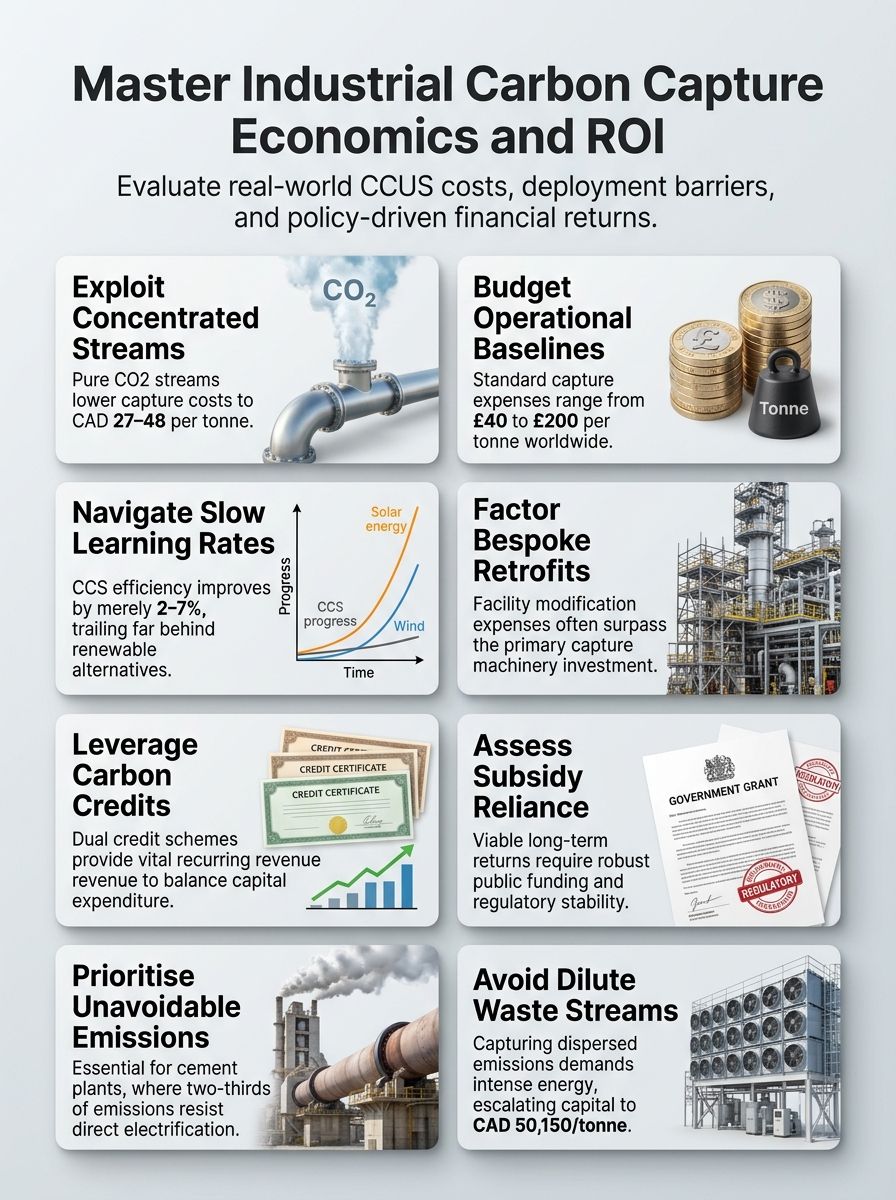
How Much Does Carbon Capture Cost per Tonne?
There is no single price. The range is wide because “carbon capture cost” can mean two different things.
One is the cost of pulling CO2 out of a gas stream. The other is the cost of capturing it, moving it and locking it away for good. A quote of $25 per tonne and a quote of $100 per tonne may both be honest if one is capture only and the other is the whole chain.
Cost per tonne of CO2 for industrial processes
The table below keeps each figure in its own currency and shows what the number covers. The evidence column tells you whether it is an expert estimate, an analyst estimate or a published range. None of these is a verified outturn from a delivered project.
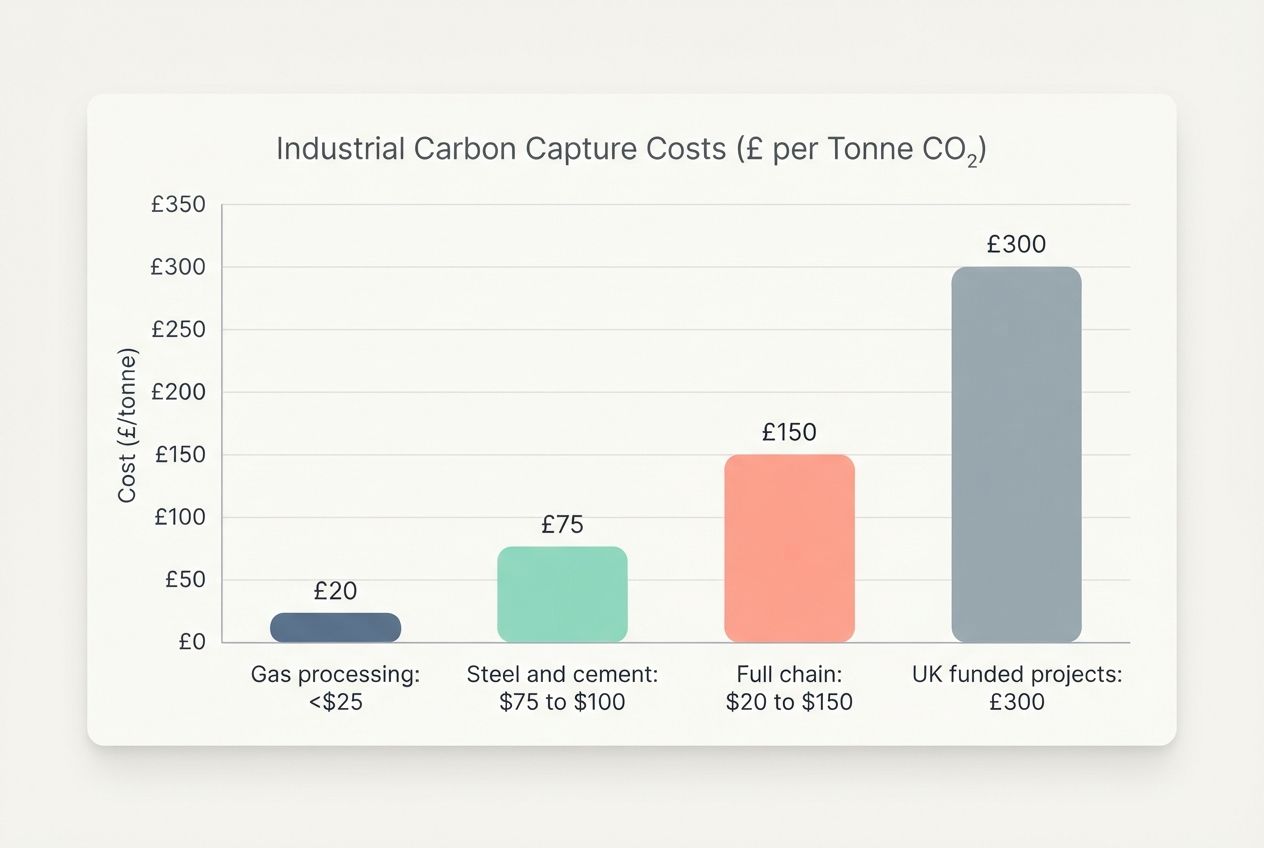
| Route or scope | Cost per tonne of CO2 | Cost boundary | Evidence type |
|---|---|---|---|
| CO2-rich industrial stacks (lowest case) | From $17 | Capture only | Published guide, lowest case |
| Gas processing plants | Under $25 | Capture only | Expert estimate, Yvonne Lam, Rystad Energy (2023) |
| Steel and cement | Up to $75 to $100 | Capture only | Upper-end expert estimate, Yvonne Lam, Rystad Energy (2023) |
| Gulf, depleted fields | $15 to $40 | Transport and storage | Analyst estimate, Rystad Energy (2023) |
| Europe, saline aquifers | $40 to $50 | Storage only | Analyst estimate, Rystad Energy (2023) |
| Full chain, global | $20 to $150, weighted average $58 | Capture, transport and storage | Analyst estimate, Wood Mackenzie (2023) |
| UK first funded projects | About £300 | Programme cost if only the initially funded projects are supported | NAO report summary (July 2024) |
Direct air capture is a different product. It can cost up to $1,100 per tonne, so it is not a comparison for a cement, steel or gas site treating its own exhaust.
Read the table from the top. Concentrated sources such as gas processing sit at the cheap end, and steel and cement sit higher.
Now add storage to capture. A steel or cement site at the upper end of $75 to $100 for capture, plus $40 to $50 for European storage, comes to $115 to $150 per tonne. That is before any separately charged transport and other excluded costs, and it is a rough guide, not a quote.
Treat $75 to $100 as an upper-end benchmark, not a planning range for every steel or cement site. Cheaper Gulf storage in depleted fields helps pull its full-chain cost down.
The NAO figure needs care too. It is a programme-level cost for the first funded projects, with a stated condition on support, and I have only the summary of the report. Do not set it against a vendor’s capture-only quote.
Why costs vary with capture method and gas concentration
The biggest single driver is how much CO2 is in the gas you treat. A stream that is already rich in CO2 needs less energy and smaller equipment to separate it. A thin stream, where CO2 is mixed with a lot of nitrogen and other gases, needs more of both.
That is why gas processing is the cheapest source and why steel and cement cost more. Concentration does not explain everything, though, because plant layout, heat supply and compression also differ by site.
Use the table below to build a shortlist. It lists the routes to assess for each stream, not a verdict. Treat each pairing as a starting point and ask the vendor to rule it in or out for your site.
| Site stream | Route to assess | Retrofit and utility questions |
|---|---|---|
| Gas processing, ammonia (concentrated CO2) | Physical absorption, chemical solvents, membranes | Low energy demand for separation. Check compression and conditioning. |
| Power and other combustion exhaust (dilute) | Post-combustion capture, sorbents | Suits existing plants but needs more energy for dilute gas. Check heat and power supply. |
| Cement kilns (dilute) | Post-combustion, oxy-fuel combustion, chemical looping | Oxy-fuel changes the kiln itself. Ask what it means for shutdowns. |
| Hydrogen production (process stream, not exhaust) | Pre-combustion capture, pressure swing adsorption | Removes CO2 before fuel is burned. Check the energy input for gas separation. |
Ask each vendor why its method fits your gas stream, and what CO2 concentration it assumed. Steel sites often have several different streams, so ask which one the quote covers.
Most published figures come from models and studies, not from many years of commercial output. Few large industrial projects have run long enough to give firm outturn data.
For a screening price, use this formula. Add the capital cost to all lifetime costs the quote includes, then divide by the lifetime tonnes on a stated basis.
The costs include operating, energy, maintenance, transport, storage and other items. The tonnes can be captured or avoided. Avoided tonnes net off the extra emissions from running the plant, so the avoided price is higher than the captured price. Never compare one with the other.
Here is an example. Say a project costs $10 million, with every assumed cost included, and avoids 100,000 tonnes in total over 5 years. The cost is $10 million divided by 100,000 tonnes, or $100 per tonne.
Spread the same cost over a longer life and the per-tonne figure falls. Capture fewer tonnes than planned and it rises. For investment appraisal, a simple division is not enough, because you also need to discount future cash flows and include financing costs.
Before you compare quotes, ask each vendor to show its working on the points below.
- Annual throughput and plant availability.
- Capture rate against net avoided tonnes.
- Heat and electricity assumptions.
- Compression and conditioning.
- Retrofit shutdowns.
- Where transport and storage start and stop.
- Monitoring and contingency.
- Price year and financing assumptions.
- Support eligibility.
Which Features Drive the Price of an Industrial Carbon Capture System?
Price is not set by one feature. Several named factors push the per-tonne figure up or down: technology type, site characteristics, CO2 purity, storage or use method, transport distance, fuel prices, capital costs, maintenance and the regulatory environment.
Use this list when you read a quote. Each item is a place where one vendor’s number can differ from another’s.
- CO2 purity and concentration. Richer streams cost less to capture, as shown above.
- Technology type. The capture route changes both the equipment and the energy it needs.
- Site characteristics. Space, layout and distance from a pipeline all matter.
- Transport distance. A longer trip to a store adds cost.
- Storage or use method. European saline aquifers cost more than Gulf depleted fields.
- Fuel and energy prices. Capture uses energy, so the price you pay for it feeds straight into the per-tonne figure.
- Capital cost and maintenance. Both are set out in the lifetime sum.
- Regulation. Rules on monitoring and storage can add work and cost.
Scalability and operational efficiency
Costs for some capture routes fall as more units are built. The clearest sourced case is direct air capture, where each doubling of capacity trims costs by roughly 18 percent. Your site is probably a different case, so treat any promise of steep cost falls with care.
Some vendors aim for modular units to bring cost down. For example, Carbon Clean targets an average capture cost of $30 per tonne with its modular CycloneCC solution. That is a vendor target, not an outturn, so ask for a site where it has been met.
Each site has its own gas, its own concentration and its own layout. That makes it harder to copy one design across many plants, which slows learning.
Integration with existing industrial processes
Most UK sites are not new builds, so retrofit is the real question. Studies have looked at retrofitting cement, pulp and paper, and petroleum refining facilities with 90% capture.
That 90% rate is an assumption in those studies. Ask whether a quote is built on the same rate, and what happens to cost if the plant captures less.
Retrofit work is where site factors bite. You need space for the plant, a route for pipework, a way to supply heat and power, and a link to transport. Ask the vendor to list each as a separate line, so none is buried in a lump sum.
High-concentration processes are usually the easiest place to start, because the CO2 is already in a rich stream. That is the same logic that makes gas processing the cheapest source in the table above.
Does Carbon Capture Pay Back? ROI, Carbon Prices and Subsidies
It depends on two things: the carbon price you face and the support you can secure. Capture only pays back on its own when the value of each tonne avoided is higher than the cost of capturing, moving and storing it.
In the UK, that gap was wide at the time of the NAO report. The NAO said that if only the initially funded projects are supported, the cost is about £300 per tonne of CO2, roughly eight times the UK carbon price then. I have not found a dated current carbon price in the sources, so check today’s price before you run your own numbers.
Long-term cost savings and carbon credits
The table below sets out the levers that decide returns, and what the sources say about each.
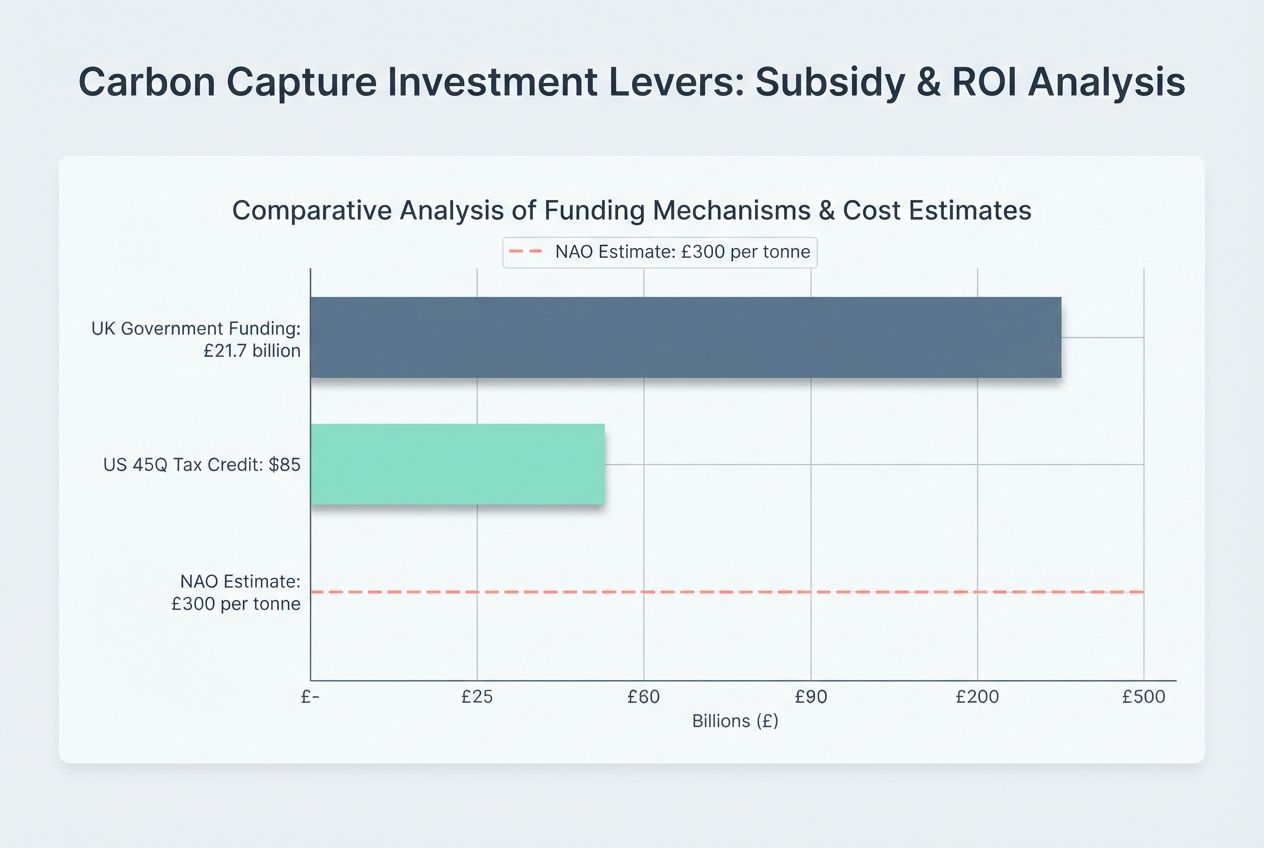
| Lever | What the sources say | What it means for ROI |
|---|---|---|
| UK carbon price | In July 2024, the NAO figure of about £300 per tonne was roughly eight times the UK carbon price. | The carbon price alone did not cover the cost then. Check the current price. |
| UK government funding | £21.7 billion over 25 years, announced October 2024, supports CCUS clusters in the North West and North East of England. | Support is aimed at clusters. Being near one does not guarantee support for your site. |
| US 45Q tax credit (international comparison) | $85 per metric ton for permanently sequestered CO2. | A yardstick only. It is not available to UK sites. |
| Timing | One vendor argues early adopters gain the most before subsidies decline and rules tighten. | A vendor view. Check it against the scheme rules you face. |
The UK has two Track-1 clusters: the East Coast Cluster (Teesside and Humberside) and HyNet (North West England and North Wales). The ECC Transport and Storage Network and Net Zero Teesside reached financial close on 10 December 2024, and HyNet T&S followed on 24 April 2025.
Track-1 targets 8.5 million tonnes per year of storage capacity, and projects start from 2028. Acorn in North East Scotland and Viking in the Humber are Track-2 clusters, identified for potential future support.
If your site is near one of these, your transport and storage costs may be shared. If it is not, a quote must price the transport leg in full. Either way, you need to establish whether your project is eligible for contracted support.
Now test the case with a cash-flow sum. The numbers below are made up to show the method. They are not UK benchmarks.
Say a site avoids 100,000 tonnes a year. Eligible carbon-price savings come to £4 million, and contracted support adds £10 million. Operating and full-chain charges are £12 million, so net cash flow is £2 million a year.
Keep upfront capital separate, to avoid counting it twice. If capital is £20 million, simple payback is 10 years before discounting, and discounting makes it longer. If net cash flow is negative, there is no payback, whatever the headline subsidy.
Run this against three scenarios: no support, partial support and full support. If the project only works in the last one, say so in the budget paper.
Economic and environmental benefits
Some sectors have few other ways to cut emissions. Cement is the clearest case, because about two-thirds of its emissions come from chemical reactions, not from fuel. Electrifying the kiln does not remove them.
For these hard-to-abate sectors, capture may be one of the few routes left. That changes the maths. The comparison is not capture against a cheap alternative, but capture against the cost of no alternative.
Wider national benefits help explain why the state pays, but they do not show up on your site’s balance sheet. Leave them out of your own ROI.
Conclusion: What to Budget and What to Ask Before You Commit
Carbon capture technology pricing starts with the route. A gas processing site can look at capture under $25 per tonne, while a steel or cement site should test a capture figure up to $75 to $100, the upper-end expert benchmark. Then add transport and storage, and check the total against Wood Mackenzie’s full-chain range of $20 to $150 per tonne, with its $58 average.
For a UK site, do not rely on the carbon price to carry the case. The NAO’s July 2024 figure of about £300 per tonne, against a carbon price roughly one eighth as high, says the return comes from support.
Before you sign anything, put these questions to every vendor:
- Is the price capture only, or does it include transport and storage?
- Is the per-tonne figure on a captured or avoided basis, and can you see the working?
- What CO2 concentration and capture rate does the price assume?
- Which of these are included: site work, energy supply, transport distance, storage method, maintenance and regulation?
- Is the figure a modelled estimate, a target or a delivered outturn?
- Which cluster, if any, will take the CO2, and what is its funding status?
- What happens to the return with no support, with partial support and with full support?
- Which currency is each figure in, and what year are the prices from?
A quote that answers all eight is one you can compare. A quote that cannot is a reason to pause.
Last, keep dollars, pounds and any other currency separate until the last step. Convert once, at the end, with a stated rate.
FAQs
1. How much does an industrial carbon capture system cost?
Costs vary widely, so ask for a full quote before you plan. Capture from concentrated sources, such as ethanol or gas processing, often runs at roughly £15 to £50 per tonne of CO2, though a 2024 UK Government report notes cement and steel plants typically cost £60 to £100 per tonne. Direct air capture costs far more still.
2. Which features push the price up?
Plant size, CO2 concentration in the flue gas, and the energy needed for the capture process matter most. Amine-based solvent systems, for example, require roughly 3 to 4 gigajoules of thermal energy per tonne of CO2 captured. Transport and storage also add real cost, so include them from day one.
3. How do I work out the ROI on carbon capture?
Add up capital cost, running cost and storage fees, then set them against carbon tax savings, credits and any government incentives. Yvonne Lam’s pricing breakdown follows this same logic: model several carbon price scenarios, not just one.
4. Is carbon capture too expensive for mid-sized firms?
Not always, and that is a common myth. Modular units and shared pipelines cut upfront spend, while the UK’s Industrial Energy Transformation Fund has awarded grants up to £30 million for qualifying projects. Tax relief can close the gap further.
RELATED POSTS
View all



Sustainable Food: Exploring the Pros and Cons of Plant-Based Meat Alternatives
August 15, 2024 | by Steve Last