

Carbon Offsets vs. Carbon Credits: Key Differences, Quality & Corporate Procurement Guide
November 7, 2026 | by Steve Last
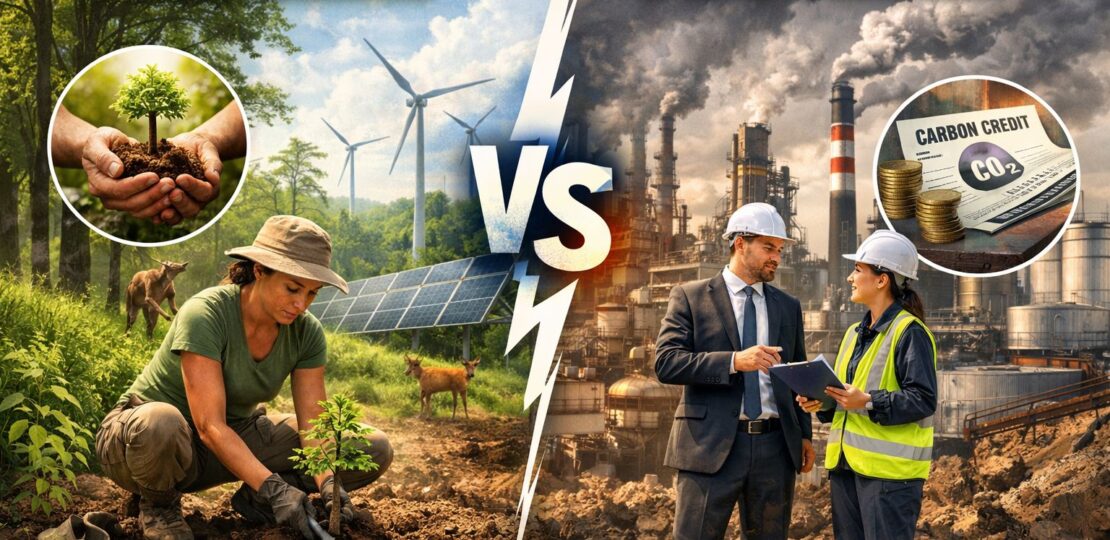
One tonne of carbon dioxide can be measured, traded, and cancelled out—but only if you know whether you’re holding a credit or buying an offset.
These two terms get thrown around like they mean the same thing, and honestly, in casual conversation they often do. But if you’re making procurement decisions, reporting emissions data, or advising a company on its climate strategy, the distinction matters a lot more than most people realize. Getting this wrong can lead to compliance headaches, wasted budget, or worse—accusations of greenwashing. Organizations like EcoRegistry have spent years helping companies sort through exactly this confusion, verifying which instruments actually deliver on their climate promises.
Key Takeaways
- A carbon credit is a tradable permit representing the right to emit one tonne of CO2, while a carbon offset is the actual emissions reduction or removal activity that compensates for emissions elsewhere.
- Companies using carbon credits decarbonize roughly twice as fast as those that don’t, according to research covering over 4,000 companies.
- Quality carbon credits must meet three criteria: additionality, permanence, and verifiable co-benefits like biodiversity restoration or community development.
- New EU reporting rules under CSRD require companies to report gross emissions and retired carbon credits separately—no more blending the two into a single “net” number.
- Later in this guide, you’ll find the exact verification standards and independent rating platforms that separate legitimate carbon projects from ones that won’t hold up to scrutiny.
Carbon Credits and Offsets: What’s Actually Different
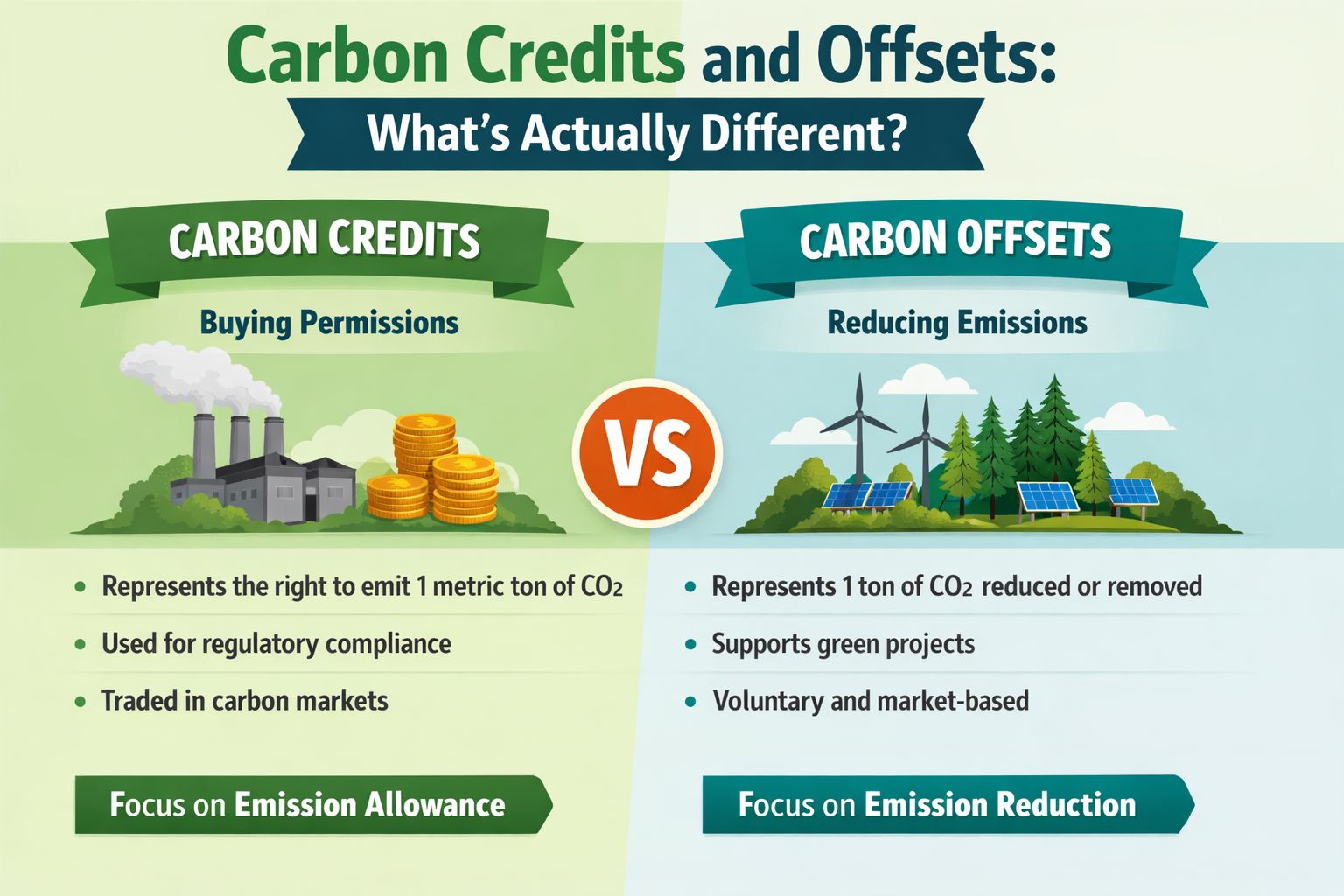
Think of a carbon credit as a permission slip and a carbon offset as the homework that earns it. One is a financial instrument; the other is an action or outcome. Mixing them up isn’t just a semantic slip—it can affect how a company structures its entire climate strategy, from which projects it funds to how it reports progress to regulators.
Both concepts orbit the same core idea: reducing the net amount of greenhouse gases in the atmosphere. But the mechanics behind each one work differently, and understanding that difference helps you ask better questions when you’re evaluating a project or a vendor. For more information, you can explore corporate carbon solutions.
The Core Definition of a Carbon Credit
A carbon credit is a tradable permit that allows a company to emit a specific amount of carbon dioxide or other greenhouse gases. Each credit typically represents one metric tonne of CO2 or its equivalent in other GHGs. Companies that use fewer credits than they’re allocated can sell their surplus to companies that need more, creating a functioning marketplace around emissions allowances.
The Core Definition of a Carbon Offset
A carbon offset represents a reduction in greenhouse gas emissions, or an increase in carbon storage, used to compensate for emissions that already happened somewhere else. This might look like planting trees, restoring degraded land, or funding a renewable energy project that displaces fossil fuel use. A carbon offset credit is the certified, transferrable version of this activity—verified by a government body or independent certifier to represent one tonne of CO2 equivalent that was avoided or removed.
Why These Terms Get Used Interchangeably
In practice, most people—including plenty of professionals—use “carbon credit” and “carbon offset” as synonyms. Both ultimately represent one tonne of CO2e avoided or removed, which explains the overlap. The real distinction comes down to origin: a credit can exist within a regulated cap-and-trade system, while an offset specifically comes from a project outside a company’s normal operations, aimed at compensating for emissions it can’t yet eliminate.
How Carbon Credits Work in Practice
Carbon credits function within what’s often called a cap-and-trade system. Regulators set a cap on total emissions allowed across an industry or region, then distribute credits that companies can use, hold, or trade. This creates a financial incentive to cut emissions, since companies that pollute less can profit by selling their unused allowances.
Trading Unused Credits Between Companies
Here’s where it gets interesting for business strategy. A manufacturer that invests in efficiency upgrades and ends up using fewer credits than allocated isn’t just saving money on compliance—they’re sitting on an asset. That company can sell its leftover credits to another business that’s over its emissions cap, creating a secondary market that rewards early movers on emissions reduction.
One Tonne of CO2e as the Universal Unit
Every carbon credit and carbon offset gets measured against the same yardstick: one metric tonne of carbon dioxide equivalent, often written as CO2e. This standardization matters because it lets wildly different projects—a wind farm in one country, a reforestation effort in another—get compared on equal footing. Without this common unit, the entire voluntary carbon market would collapse into incompatible, unverifiable claims.
What Makes a Carbon Offset Project Legitimate
Not every tree-planting initiative or renewable energy investment qualifies as a legitimate carbon offset. For a project to count, it needs to represent activity that falls outside a company’s normal day-to-day operations and produces a measurable, verifiable reduction in greenhouse gases.
Investment Outside Day-to-Day Operations
Carbon offsets get created when a business funds something specifically designed to reduce greenhouse gas emissions—separate from whatever that business normally does. A tech company doesn’t offset its data center emissions by simply running its servers more efficiently; that’s just operational improvement. Instead, offsetting means investing in an external project, like forest conservation or methane capture, that wouldn’t have happened otherwise.
Third-Party Certification Requirements
Legitimate offset projects don’t get to self-certify. They need independent verification from recognized bodies to confirm the claimed emissions reduction actually happened and will continue to hold up over time. This certification process is what transforms a vague environmental promise into something a company can actually point to in its sustainability reporting—and it’s the same certification that typically generates the carbon credits companies trade on voluntary markets.
Indonesia’s Role in the Global Carbon Market
Few places illustrate the stakes of carbon offsetting better than Indonesia. Its rainforests rank among the third-largest in the world, and they hold an extraordinary amount of carbon that, once released, would be nearly impossible to recapture on any meaningful timescale. Learn more about the significance of carbon credit in global environmental efforts.
Irrecoverable Carbon Storage Compared to the Amazon
Indonesia’s rainforests store roughly 200 tons of irrecoverable carbon per hectare—double the 100 tons per hectare found in the Amazon. That figure alone explains why conservation finance has poured into Indonesian forest protection projects over the past decade. Losing these forests wouldn’t just release stored carbon; it would eliminate carbon sinks that took centuries to develop.
Financial Incentives From Rainforest Preservation
Carbon offset programs tied to deforestation prevention, often under frameworks like REDD+ (Reduction of Emissions from Deforestation and Forest Degradation), give companies in developed countries a direct financial mechanism to fund rainforest protection. These programs work alongside other common offset strategies—reforestation, wind energy investment, and large-scale renewable energy development—to create a portfolio approach to emissions compensation rather than relying on a single project type.
The Three Pillars of High-Quality Carbon Credits
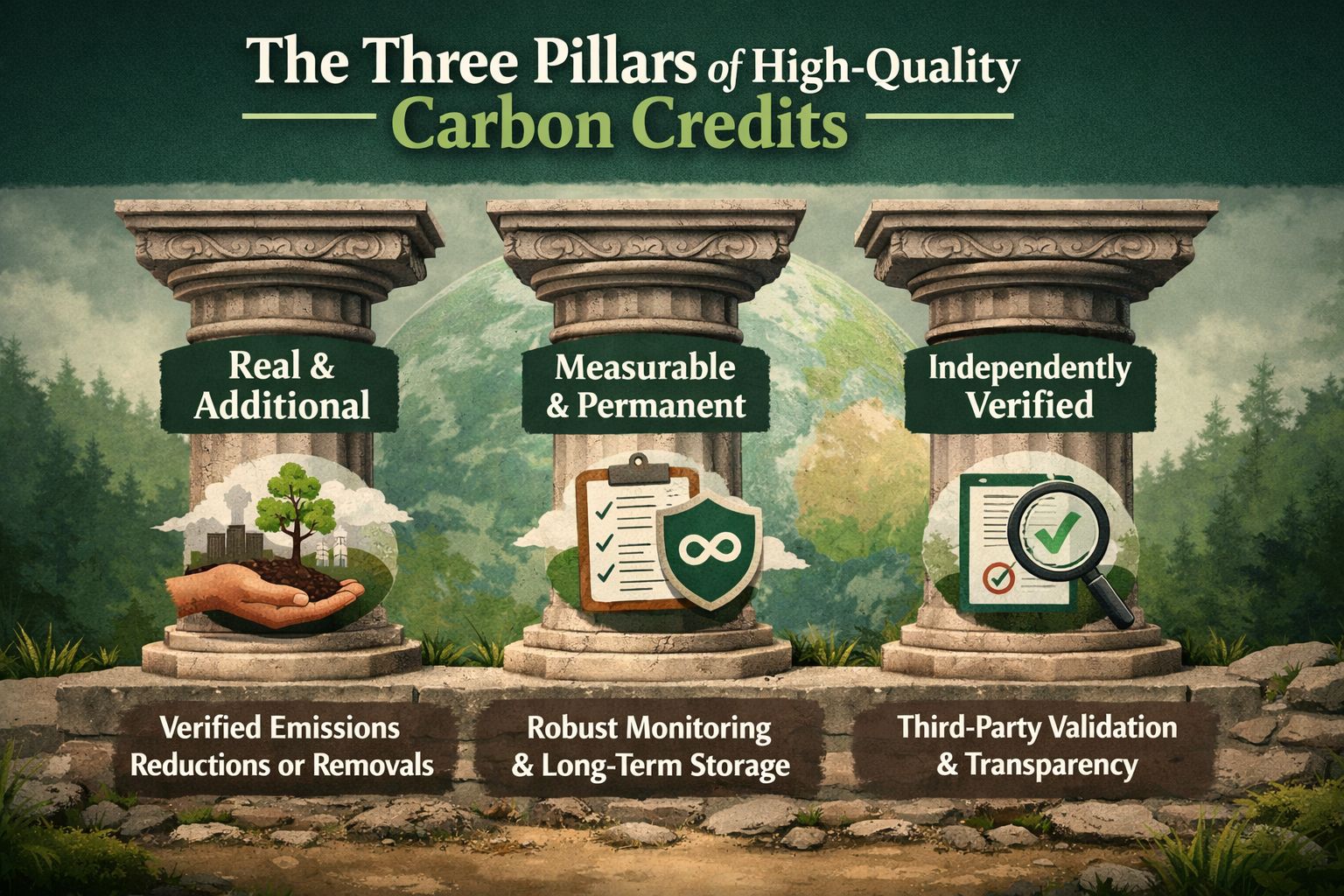
Not all carbon credits are created equal, and treating them as interchangeable is one of the fastest ways to end up with a portfolio full of worthless paper. Quality comes down to three specific pillars, and skipping any one of them undermines the entire value of the credit.
Additionality: Would This Project Exist Without Carbon Finance
Additionality asks a simple but critical question: would this emissions reduction have happened anyway, without money from selling carbon credits? If a solar farm was already fully funded and under construction before carbon finance entered the picture, the credits generated from it don’t represent a real additional benefit—they’re just taking credit for something that was going to happen regardless. Genuine additionality means the carbon revenue was the deciding factor that made the project financially viable.
Permanence: How Long Does the Carbon Stay Locked Away
Permanence addresses durability. A forest that stores carbon for decades provides real climate value, but if that same forest burns down in a wildfire five years later, the stored carbon releases right back into the atmosphere—undoing the entire benefit. This is why permanence has become such a central issue in carbon market quality debates, particularly for nature-based projects that face ongoing risks from fire, disease, and land-use change.
Co-Benefits: Measuring Social and Environmental Wins
Beyond the carbon math, the best projects deliver measurable social and environmental gains that extend well past emissions reduction. These co-benefits turn a carbon credit from a simple accounting tool into something that genuinely improves conditions on the ground for the people and ecosystems involved.
High-quality offset projects commonly generate several types of co-benefits worth tracking:
- Biodiversity restoration, including habitat protection for endangered species
- Improved water security for surrounding communities
- Sustainable livelihoods and job creation in vulnerable regions
- Community development funding tied directly to project revenue
- Greater environmental resilience against climate-related disasters
When a company evaluates potential credit purchases, co-benefits shouldn’t be treated as a nice-to-have afterthought. They’re often the clearest evidence that a project is doing real work beyond just generating a tradable certificate.
How to Verify Carbon Credit Quality Before You Buy
Buying carbon credits without verification is a bit like buying a used car without checking under the hood—you might get lucky, but the odds aren’t in your favor. Fortunately, the market has developed tools specifically designed to separate legitimate projects from ones that won’t survive scrutiny.
Trusted Standards: Verra, Gold Standard, and Core Carbon Principles
Sourcing credits from recognized standards bodies is the first line of defense against low-quality or fraudulent credits. Verra and Gold Standard remain two of the most widely used certification systems in the voluntary carbon market, each with their own methodology requirements and auditing processes. Credits carrying the Integrity Council’s Core Carbon Principles label have cleared an additional layer of scrutiny specifically designed to address concerns about additionality and permanence.
Choosing a standard isn’t just a box-checking exercise—it directly affects how defensible your sustainability claims will be if regulators, journalists, or watchdog groups ever ask you to justify them.
Independent Rating Platforms Like Sylvera and BeZero
Beyond certification standards, independent rating platforms have emerged to provide an additional layer of quality assessment. Sylvera and BeZero both analyze carbon projects using satellite data, scientific modeling, and on-the-ground verification to assign quality ratings that go beyond what certification alone can confirm.
These platforms function somewhat like credit rating agencies for carbon projects, giving buyers a quick reference point before committing budget to a specific portfolio. Relying on certification alone has become increasingly risky as the market has grown more crowded with projects of wildly varying quality. For more comprehensive insights, explore various climate change risk management strategies that can help in evaluating these projects.
For forestry projects specifically, buyers should confirm the existence of buffer pools—reserve credits set aside to cover losses if a project experiences reversal through fire, disease, or illegal logging. Monitoring systems should also be in place to track the project’s status well after the initial credits get issued, since permanence risk doesn’t disappear once a deal closes.
- Check whether the project uses a recognized methodology approved by Verra, Gold Standard, or an equivalent body
- Confirm independent verification has occurred, not just self-reported data from the project developer
- Look up the project’s rating on platforms like Sylvera or BeZero if available
- Ask specifically about buffer pool size and monitoring frequency for forestry-based projects
- Request documentation on co-benefits claims, not just carbon reduction figures
Running through this kind of checklist before finalizing a purchase takes extra time upfront, but it’s far less costly than discovering months later that a flagship offset project didn’t hold up to outside scrutiny.
Questions to Ask During Due Diligence
Due diligence on a carbon project should examine the underlying methodology, assess whether permanence safeguards actually exist on paper and in practice, and verify any claimed social or environmental co-benefits with supporting documentation. It helps to ask the project developer directly: what happens if this project fails to deliver the promised carbon reduction? A credible answer should include specific contingency plans, not vague reassurances. For a deeper understanding of these processes, consider exploring carbon offsets vs. carbon credits to see how they impact project viability.
Building a Smart Corporate Procurement Strategy
Buying carbon credits shouldn’t be a last-minute decision made to hit a year-end sustainability target. The companies getting the most value from their carbon credit purchases treat procurement as a deliberate, strategic process rather than a reactive compliance exercise.
Define Why You’re Buying Credits First
Before purchasing a single credit, business leaders need clarity on what they’re actually trying to accomplish. Are these credits meant to address unavoidable Scope 3 emissions? Support a specific regional conservation goal tied to supply chain operations? Meet an investor expectation around net-zero commitments? The answer shapes everything downstream, from which project types to prioritize to how the purchase gets communicated externally.
Cutting emissions internally should always come before buying offsets to compensate for what’s left. Credits work best as the final step in a broader decarbonization plan, not a substitute for doing the harder internal work first.
- Identify which emissions categories (Scope 1, 2, or 3) the credits are meant to address
- Set a clear internal reduction target that comes before any offset purchase
- Decide whether removal credits or reduction credits better fit your climate goals
- Determine your budget range based on current voluntary market pricing
Skipping this step is one of the most common reasons companies end up with a scattered, hard-to-explain portfolio of credits that don’t tell a coherent story.
Match Projects to Your Business Values and Operations
A food and beverage company sourcing ingredients from tropical regions might find more strategic value in forest conservation credits tied to its supply chain geography, compared to a tech company that might align better with renewable energy or direct air capture projects. This alignment makes the eventual sustainability reporting more credible and easier to explain to stakeholders, since the connection between the business and the project feels natural rather than arbitrary.
Treat Credits as a Capital Allocation Decision
Carbon credit purchases deserve the same financial scrutiny as any other capital allocation decision a company makes. That means evaluating price against quality, comparing multiple project options, and building in room for price fluctuation as market demand shifts.
Prices in the voluntary carbon market are likely to climb as demand for high-integrity removal credits continues outpacing available supply. Companies that lock in agreements with credible projects now may find themselves in a stronger position than those waiting until prices rise further—though this should never come at the expense of proper due diligence on quality carbon credits.
The Business Case for Buying Carbon Credits
Skeptics sometimes frame carbon credits as a way for companies to buy their way out of real climate responsibility. The data tells a more interesting story, suggesting that companies engaging seriously with carbon markets tend to be more ambitious about emissions reduction overall, not less. To support these efforts, many companies are turning to carbon management software to track and optimize their carbon credit strategies effectively.
A study examining over 4,000 companies found a clear pattern worth paying attention to: businesses already decarbonizing tend to also be the ones most actively engaged in carbon markets. This correlation doesn’t mean credits alone cause faster decarbonization, but it does challenge the assumption that buying offsets lets companies off the hook from doing the harder internal work.
Beyond the climate impact itself, there’s a growing business case tied directly to brand reputation, employee satisfaction, and financial performance that makes carbon credit engagement look less like a cost center and more like a strategic investment.
Companies Using Credits Decarbonize Twice as Fast
Companies using carbon credits were, on average, decarbonizing at about twice the rate of those that weren’t engaged in voluntary carbon markets at all. This finding pushes back directly against the common criticism that offsets let companies avoid real emissions work—the data suggests the opposite relationship.
Higher Investment in Emissions Reduction
Companies engaged in voluntary carbon markets are 1.8 times more likely to be decarbonizing year-over-year compared to companies sitting on the sidelines. These same companies invest three times more capital into reducing their own emissions, and they’re significantly more likely to have set ambitious science-based environmental targets in the first place.
Consumer Preference for Sustainable Brands
Consumer sentiment has shifted considerably toward sustainability-focused purchasing decisions. Roughly 87% of consumers say they prefer buying from brands that demonstrate genuine sustainability commitments, which puts real market pressure on companies to back up their climate claims with verifiable action rather than vague marketing language.
This preference isn’t just a passing trend tied to younger demographics—it’s increasingly influencing purchasing behavior across a wide range of consumer segments, making credible sustainability credentials a competitive differentiator rather than a nice-to-have extra.
Better Financial Performance and Employee Morale
Sustainable companies consistently show better operational performance, lower capital costs, and valuations that run roughly 20% higher than less sustainability-focused competitors. Internally, these companies also report 55% higher employee morale, 38% greater employee loyalty, and a 16% boost in overall productivity—numbers that suggest sustainability commitments pay dividends well beyond the environmental impact itself.
Avoiding Greenwashing in Your Climate Claims
Buying high-quality carbon credits means little if the communication around them is vague, misleading, or impossible to verify. Greenwashing accusations have increasingly targeted companies making broad sustainability claims without the documentation to back them up, and regulators are paying closer attention than ever before.
Why Vague “Carbon Neutral” Claims Backfire
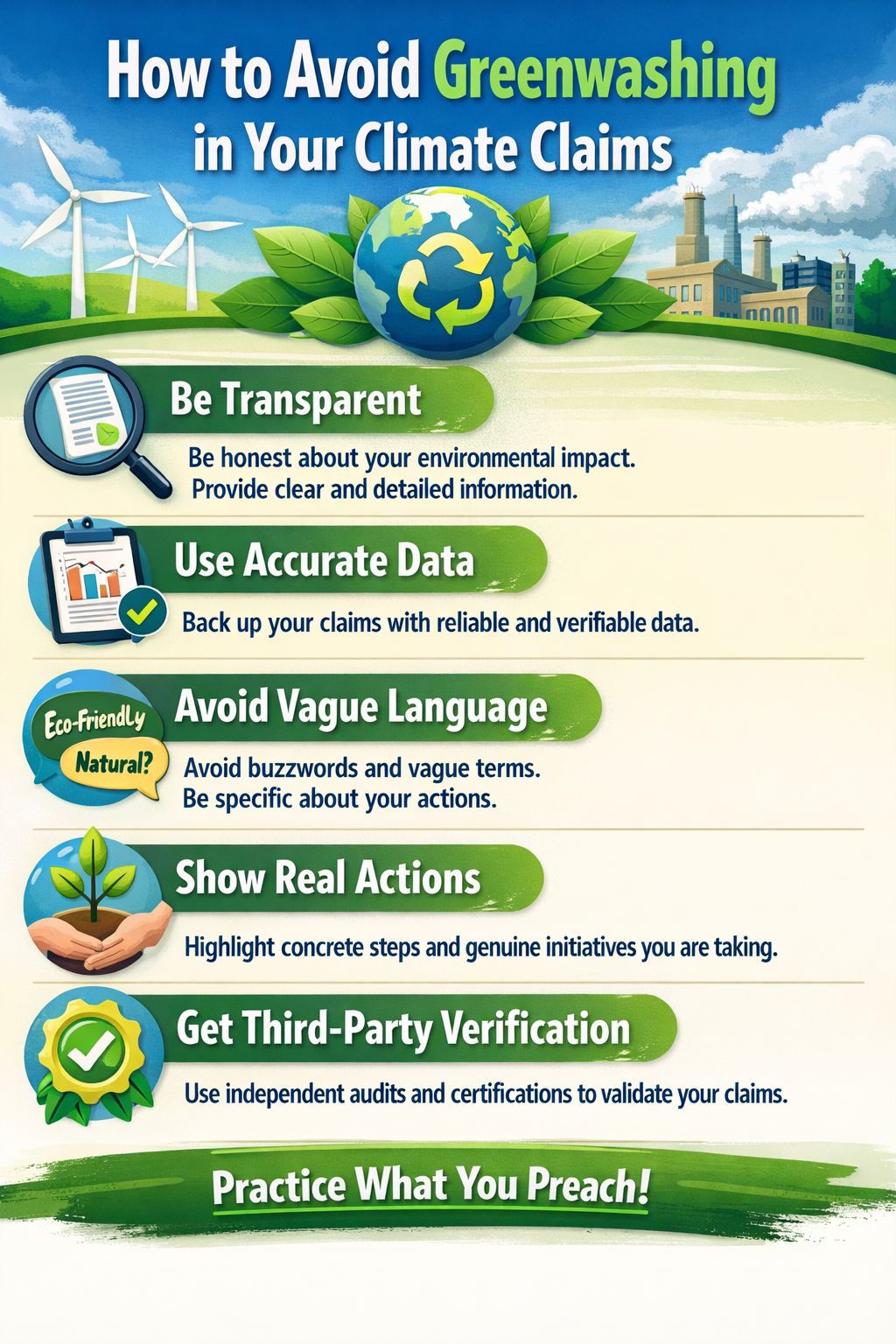
Blanket statements like “carbon neutral” have become a liability rather than an asset unless they’re backed by robust, specific evidence and framed clearly within a company’s broader net-zero pathway. Journalists, watchdog organizations, and increasingly regulators are quick to question these claims when companies can’t point to exactly which credits were purchased, what standard certified them, or how much of the company’s footprint they actually address.
The safest approach treats transparency as a competitive advantage rather than a legal obligation to minimize. Companies willing to show their work—including the parts of their carbon strategy that are still a work in progress—tend to fare much better in public perception than those hiding behind polished but vague language.
How to Write Specific, Defensible Statements
Specificity is the antidote to greenwashing accusations. Instead of saying “we’re carbon neutral,” a more defensible statement looks like this: “We reduced our emissions by 35% and invested in certified reforestation projects addressing the remainder.” This kind of language gives stakeholders something concrete to evaluate rather than a claim they simply have to trust.
Specific statements also hold up better over time. If a company later faces questions from investors, journalists, or regulators, having documented exactly which credits were purchased, from which standard, and what percentage of emissions they cover makes the conversation far easier than scrambling to justify a vague claim after the fact. For companies looking to improve their carbon strategies, exploring carbon management software can be a valuable step.
Companies that get this right typically build out a short, plain-language disclosure alongside their sustainability reporting—something that explains, in a sentence or two, exactly what action was taken and what it accomplished. It doesn’t need to be complicated, but it does need to be accurate and traceable.
Offsets and Emissions Cuts: The Right Order of Operations
There’s a sequence that matters here, and skipping steps is where companies get into trouble. High-quality carbon offsetting allows companies to take immediate, measurable action on emissions they can’t yet eliminate internally, but that only works as intended when internal reduction comes first.
Science is clear on this point: in credible net-zero strategies, offsets aren’t an alternative to internal reductions. They’re the complementary step that makes a net-zero strategy complete, filling the gap for emissions that current technology or operational changes simply can’t eliminate yet.
The 90% Reduction Rule From the Science Based Targets Initiative
The Science Based Targets initiative, widely known as SBTi, sets a clear expectation for companies pursuing credible net-zero targets. Internal emissions reduction has to come first, with companies expected to cut their own emissions by at least 90% before using high-quality removals to neutralize whatever remains. This 90% threshold prevents companies from leaning too heavily on offsets as a shortcut around the harder work of operational change.
Tackling Scope 3 Emissions With Offsets
Offsets prove particularly valuable for addressing Scope 3 emissions—the indirect emissions scattered throughout a company’s value chain, often from suppliers, transportation, or product use. These emissions frequently make up the majority of a company’s total footprint, yet they’re also the hardest to control directly since they happen outside a company’s own operations. Carbon credits give businesses a practical tool to address this portion of their footprint while they work on longer-term supply chain changes.
Locking in Prices Before the Market Tightens
Carbon prices in the voluntary market are likely to rise as demand for high-integrity removal credits continues outpacing available supply. Companies that secure agreements with credible, well-verified projects now may avoid paying significantly more down the road, though price shouldn’t ever override the quality checks covered earlier in this guide.
Reporting Carbon Offsets Correctly Under New Regulations
Regulatory scrutiny around carbon offset reporting has tightened considerably, particularly in the European Union, where new rules have fundamentally changed how companies are allowed to present their climate data. Understanding these requirements isn’t optional anymore for companies operating in or selling into EU markets.
These changes reflect a broader shift away from trusting self-reported sustainability claims and toward requiring the kind of granular, verifiable detail that makes greenwashing much harder to get away with.
EU CSRD Rules on Separating Emissions From Offsets
The EU’s Corporate Sustainability Reporting Directive, known as CSRD, now requires businesses to present carbon offset disclosure separately from gross emissions figures. Netting the two together into a single, flattering number is no longer permitted under these reporting standards.
In practice, this means companies have to structure their disclosures in a very specific way rather than relying on summary statements.
- Report total gross emissions first, without any offset adjustments factored in
- Separately disclose the quantity of verified carbon credits retired during the reporting period
- Avoid combining these two figures into a single net number anywhere in public reporting
- Clearly label which emissions scope the retired credits are intended to address
A compliant disclosure statement would read something like: “We emitted X tonnes CO2e and retired Y tonnes of verified carbon credits,” rather than simply reporting a reduced net figure that obscures the original emissions total.
ESRS E1 Breakdown Requirements by Project Type and Location
Beyond the basic separation of emissions and offsets, the European Sustainability Reporting Standards under ESRS E1 expect companies to break down their carbon credits in much greater detail. This includes specifying whether credits come from reduction projects or removal projects, which certification standard applies (such as Verra or Gold Standard), where the project is physically located, and whether the credits include Paris Agreement corresponding adjustments.
Avoiding Double Counting With Corresponding Adjustments
Corresponding adjustments exist to prevent the same emissions reduction from being counted twice—once by the country where the project is located, and again by the company that purchased the credit. This becomes especially relevant for credits tied to international projects, where host countries may also want to count the reduction toward their own national climate commitments under the Paris Agreement.
Without a corresponding adjustment, there’s a real risk that the same tonne of avoided emissions gets claimed by two different parties, inflating the apparent climate benefit of the transaction. Companies sourcing credits from international projects should specifically ask whether corresponding adjustments have been applied, since this detail is increasingly expected under stricter reporting frameworks.
Getting this wrong doesn’t just create a compliance headache—it undermines the entire credibility of the carbon credit system, which depends on each tonne of reduction being counted exactly once.
Where the Voluntary Carbon Market Is Headed
The voluntary carbon market is clearly moving toward greater transparency, stricter quality standards, and tighter regulatory oversight. Prices for high-integrity removal credits are expected to climb as demand grows faster than the supply of genuinely verified projects, which means companies that start building credible carbon strategies now are likely to be in a stronger position than those waiting for the market to force their hand. Organizations like EcoRegistry continue working to make project verification more accessible, helping bridge the gap between ambitious corporate climate goals and the on-the-ground reality of what makes a carbon project trustworthy.
Frequently Asked Questions
Is a Carbon Offset the Same as a Carbon Credit?
Not exactly, though the terms get used interchangeably in everyday conversation. A carbon credit is a tradable permit representing the right to emit one tonne of CO2, while a carbon offset is the actual project or activity—like reforestation or renewable energy investment—that reduces or removes emissions to compensate for emissions elsewhere. Certified offset projects typically generate the carbon credits that get traded on voluntary markets.
How Much Does One Carbon Credit Typically Represent?
One carbon credit represents one metric tonne of carbon dioxide, or the equivalent amount of another greenhouse gas. This standardized unit, often written as CO2e, allows vastly different project types—from wind farms to forest conservation—to be compared and traded on equal terms. To understand the difference between carbon credits and offsets, you can explore this comparison guide.
Without this common measurement standard, the voluntary carbon market wouldn’t be able to function as a coherent trading system at all.
What Should I Look for in a High-Quality Carbon Offset Project?
Quality comes down to three core factors worth checking before any purchase.
- Additionality: confirm the project wouldn’t have happened without carbon finance
- Permanence: verify safeguards exist against reversal through fire, disease, or land-use change
- Co-benefits: look for documented social and environmental gains beyond just carbon reduction
Beyond these three pillars, sourcing credits from recognized standards like Verra or Gold Standard, and cross-checking project quality through independent platforms like Sylvera or BeZero, adds another layer of confidence before committing budget.
Forestry projects specifically should have buffer pools and ongoing monitoring systems in place, since these projects carry higher permanence risk than many other offset types.
Can Buying Carbon Credits Replace Reducing My Own Emissions?
No, and credible frameworks like the Science Based Targets initiative are explicit about this. Companies are expected to reduce their own emissions by at least 90% before using high-quality removal credits to address whatever remains. Carbon credits work best as a complementary tool for hard-to-eliminate emissions, not a substitute for the harder work of operational change.
How Do I Avoid Greenwashing When Reporting Carbon Offsets?
Specificity is the key defense against greenwashing accusations. Replace vague claims like “carbon neutral” with precise statements that name exact figures, certification standards, and project types—something like “we reduced emissions by 35% and retired verified credits from a Gold Standard-certified reforestation project” for the remainder.
Under EU CSRD rules, this level of detail isn’t just good practice anymore; it’s a legal requirement for companies reporting in European markets, which report gross emissions and retired credits separately rather than blending them into a single net figure.
Ready to build a carbon strategy that actually holds up to scrutiny? EcoRegistry helps companies verify, track, and report high-integrity carbon credits with the transparency today’s regulations and stakeholders demand.
RELATED POSTS
View all

 Photo by Matt Palmer on Unsplash
Creating a Sustainable Future: Setting Carbon Emission Reduction Targets
August 5, 2023 | by Steve Last
 Photo by Chris LeBoutillier on Unsplash
 Photo by Marina Lakotka on Unsplash
The Path to a Sustainable Future: Setting Carbon Emission Reduction Targets for Net-Zero 2050
August 5, 2023 | by Steve Last