

First Solar vs. SunPower: Battery Storage Capacity, Cost & Grid Integration
November 7, 2026 | by Steve Last

If you’re comparing First Solar and SunPower hoping to find battery storage specs side by side, here’s the short answer: First Solar doesn’t make home batteries at all, while SunPower offers panels that pair with third-party storage systems.
That distinction trips up a lot of homeowners doing their solar research, and it’s worth untangling before you spend another minute comparing spec sheets that don’t actually compete with each other. Understanding how battery storage technology works—regardless of which panel brand you choose—is what actually determines your energy independence and your monthly bill. Companies like Totlpower have built their entire business around solving the storage half of that equation, which is exactly where this comparison gets interesting.
Key Takeaways
- First Solar manufactures utility-scale thin-film solar panels and does not produce home battery storage systems.
- SunPower makes highly-rated residential PV panels but relies on partner companies for battery storage integration.
- LiFePO4 batteries, the technology behind most modern home storage systems, offer 6,000 to 8,000 charge cycles and 80-90% depth of discharge.
- A 100 Ah 12V LiFePO4 battery costs $100 to $300 upfront, with a levelized storage cost around $0.123 per kWh.
- Keep reading to see how brands like Tesla, Enphase, and Totlpower stack up when it comes to actual battery capacity, cost, and grid integration features.
First Solar Builds Panels, Not Home Batteries—Here’s Why That Matters
First Solar has built its reputation on thin-film cadmium telluride (CdTe) panel technology, sold almost exclusively into utility-scale and commercial solar farms rather than residential rooftops. If you’re shopping for a home battery to pair with First Solar panels, you won’t find one with the First Solar name on it—you’ll need to look at third-party storage providers instead. This matters because it changes the entire comparison: you’re not really choosing between “First Solar batteries” and “SunPower batteries,” you’re choosing how each panel brand’s ecosystem connects to the broader battery storage market.
SunPower vs. First Solar: Two Different Business Models
SunPower and First Solar aren’t really competing for the same customer, and that’s the first thing to understand before you get deep into specs and pricing. One company builds for homeowners who want rooftop panels and a battery backup plan; the other builds massive solar farms that power entire grids.
Once you see the split in business models, the rest of the comparison makes a lot more sense. Here’s how each one actually operates in the market.
First Solar’s Focus on Utility-Scale Thin-Film Panels
First Solar’s thin-film modules are designed for large installations—think solar farms spanning hundreds of acres, not a single-family roof. These panels prioritise lower manufacturing cost per watt at scale rather than the compact, high-efficiency design homeowners typically need. Because of this focus, First Solar simply isn’t in the residential battery conversation, and pairing its panels with a home storage system isn’t something the company offers as a packaged solution. For those interested in broader sustainability goals, consider exploring paths to net-zero 2050 goals.
SunPower’s Residential Panel and Storage Approach
SunPower, on the other hand, has built its name on residential-grade panels that consistently rank among the highest-rated in independent user reviews. Rather than manufacturing its own battery, SunPower has historically partnered with storage providers to offer bundled systems for homeowners. That means your actual battery experience—capacity, cycle life, warranty—depends less on the SunPower name and more on which storage partner is behind the panel.
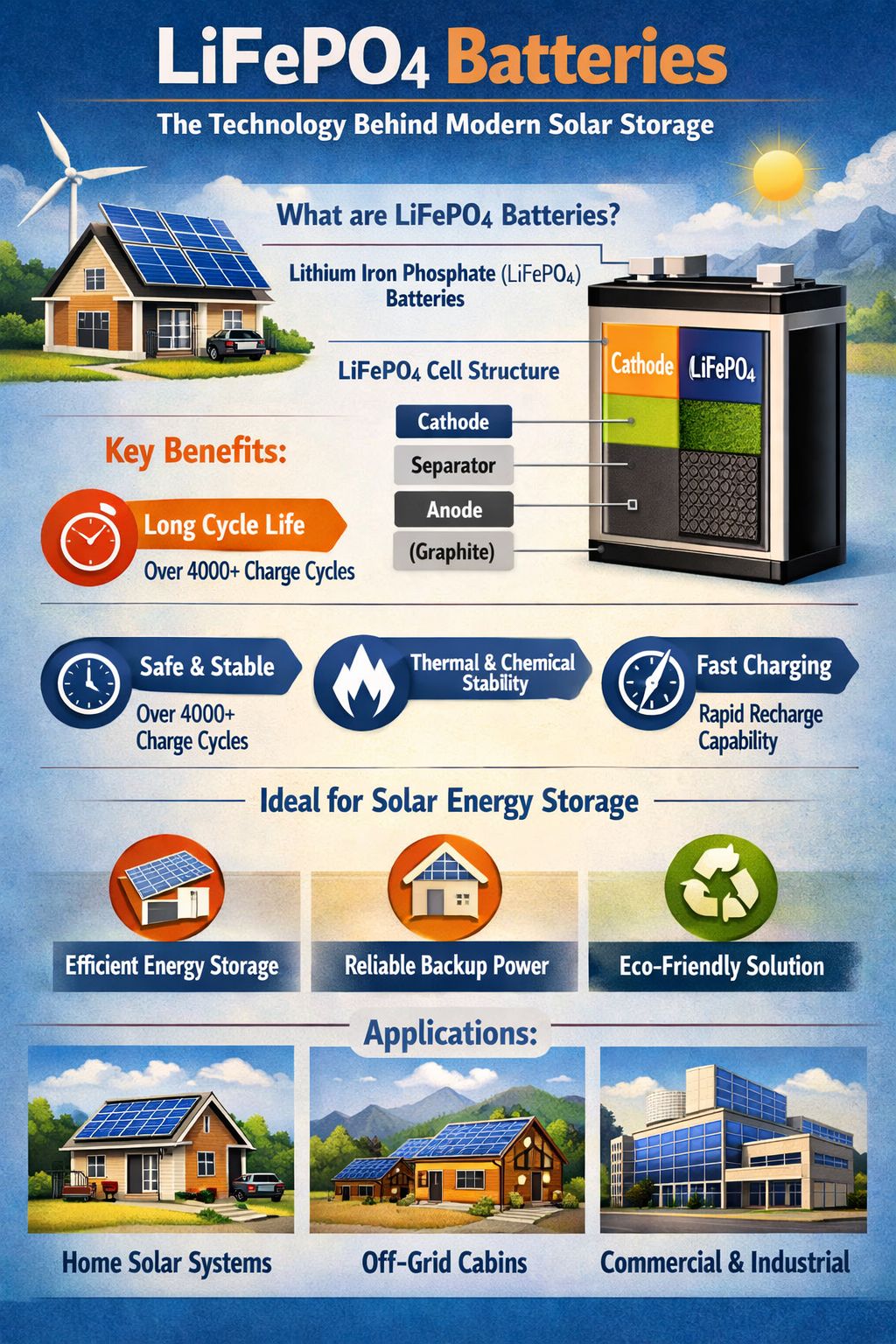
LiFePO4 Batteries: The Technology Behind Modern Solar Storage
No matter which panel brand ends up on your roof, there’s a good chance the battery sitting in your garage runs on lithium iron phosphate (LiFePO4) chemistry. This has become the go-to technology for home solar storage, and for good reason—it’s safer and more stable than older lithium-ion formulations, which matters a lot when you’re storing energy inside your house.
How Lithium Iron Phosphate Batteries Actually Work
LiFePO4 batteries store and release energy by shuttling lithium ions back and forth between the battery’s electrodes. The cathode material—lithium iron phosphate—is what gives this chemistry its name and its reputation for thermal stability. Compared to other lithium-ion formulas, LiFePO4 is less prone to overheating, which is one reason it’s become the standard for residential energy storage.
Cycle Life: Why 6,000 to 8,000 Charges Matters
Cycle life tells you how many times a battery can be fully charged and discharged before it starts losing meaningful capacity, and LiFePO4 batteries typically handle 6,000 to 8,000 cycles. If you’re cycling your battery once a day, that translates to roughly 16 to 22 years of use before performance drops off significantly. Compare that to older lead-acid batteries, which often tap out after a few hundred cycles, and it’s easy to see why LiFePO4 dominates the current market.
Depth of Discharge and Efficiency Ratings Explained
Depth of discharge (DoD) measures how much of a battery’s total capacity you can actually use without damaging it, and LiFePO4 batteries typically allow 80-90% DoD. Pair that with round-trip efficiency in the 90-95% range, and you’re looking at a battery that wastes very little energy between the moment it’s charged and the moment you actually use that power. These two numbers together are a big part of why LiFePO4 has become the benchmark chemistry for home solar storage.
Breaking Down the Real Cost of a LiFePO4 Battery System
Once you understand how LiFePO4 batteries work, the next logical question is what they’ll actually cost you. The answer breaks down into a few distinct line items—purchase price, installation, maintenance, and the long-term cost per kilowatt-hour you’ll actually use.
Upfront Price for a 100 Ah 12V Battery
A standard 100 Ah 12V LiFePO4 battery, which stores about 1.2 kWh of usable energy, runs between $100 and $300 depending on the brand and quality of components. That price range reflects differences in build quality, warranty length, and whether the battery includes an integrated battery management system or requires a separate one.
Installation Costs You Need to Budget For
Installation adds another $50 to $150 on top of the battery’s purchase price, though your final number depends heavily on your home’s existing electrical setup and how complex the wiring job turns out to be. Homes with newer panels and accessible wiring tend to land on the lower end of that range, while older homes requiring panel upgrades can push costs higher.
Annual Maintenance: Why It’s Nearly Free
Here’s the good news: LiFePO4 batteries are about as low-maintenance as home energy equipment gets, with annual upkeep costs estimated at just $10 per year. Unlike lead-acid batteries that demand regular fluid checks and terminal cleaning, LiFePO4 systems are largely self-managing thanks to their built-in battery management systems.
Levelized Cost of Storage Per kWh
When you spread the total cost of a LiFePO4 battery across its entire lifespan, you get what’s called the levelized cost of storage—and for a 100 Ah 12V battery operating at 90% depth of discharge over 6,000 cycles, that number comes out to roughly $0.123 per kWh. That figure is what actually matters when comparing battery value, since it accounts for purchase price, cycle life, and usable capacity all in one metric.
Cost Category | Typical Range |
|---|---|
Battery Purchase (100Ah 12V) | $100–$300 |
Installation | $50–$150 |
Annual Maintenance | ~$10/year |
Levelized Cost of Storage | ~$0.123/kWh |
Why LiFePO4 Batteries Cost More Than Other Types
If you’ve shopped around, you’ve probably noticed LiFePO4 batteries carry a higher price tag than traditional lead-acid options. That premium comes down to raw materials—lithium, iron, and phosphate aren’t cheap to source, and the manufacturing process demands high-purity versions of each to guarantee safety and longevity.
That extra manufacturing precision isn’t just about hitting a spec sheet number. High-purity materials directly reduce the risk of thermal issues and extend the battery’s usable cycle life, which is exactly why LiFePO4 outlasts cheaper alternatives by thousands of charge cycles despite the higher sticker price.
Turning Your Battery Into a Money-Maker Through the Grid
A solar battery isn’t just a backup power source sitting in your garage—it can actually generate income if you understand how time-of-use rates and net metering work in your area. The strategy is simple: charge when electricity is cheap, use or sell it back when electricity is expensive.
This isn’t theoretical. Homeowners in markets with strong time-of-use pricing are already doing this every single day, and the math works out in their favor.
California’s Off-Peak Charging, Peak-Hour Selling Strategy
In California, homeowners can charge their battery during off-peak hours at around $0.26/kWh, then sell that stored energy back to the grid during peak hours at $0.66/kWh through net-metering. That spread creates a profit of $0.28/kWh on every unit of energy you cycle through your battery this way.
- Charge during off-peak hours at $0.26/kWh
- Store the energy in your LiFePO4 battery
- Sell back during peak demand at $0.66/kWh via net-metering
- Pocket the $0.28/kWh difference as pure profit
Obviously, this strategy depends entirely on your local utility’s rate structure, so it’s worth checking your specific time-of-use rates before assuming you’ll see the same spread. But where the pricing gap exists, a battery stops being just a backup system and starts functioning like a small, automated trading account. To further understand how this fits into broader sustainability goals, consider exploring the path to net-zero 2050 goals.
How Feed-In Tariffs Pay You for Solar Exports
Outside the U.S., feed-in tariffs create a similar opportunity. In the UK, for example, some homeowners earn 12p/kWh for solar exports while paying just 6.9p/kWh for overnight charging—meaning the export rate alone almost doubles what you paid to charge in the first place.
Near-Zero Energy Bills With a 7.6kW System and Tesla Powerwall Plus
Real-world numbers back this up. One homeowner running a 7.6 kW peak PV solar system with Tesla solar panels and a single Tesla Powerwall Plus reports paying near zero in annual energy costs, and actually receives a check each year from excess solar production sold back to the grid.
- System size: 7.6 kW peak PV solar electric array
- Battery: One Tesla Powerwall Plus (13.5 kWh usable capacity)
- Annual outcome: Near-zero energy costs plus a yearly payout check
That kind of result isn’t guaranteed for every household, since it depends on your system size, local rates, and how much excess energy you actually generate. But it illustrates exactly what’s possible when panel output, battery capacity, and grid pricing all line up in your favor.
Solar Storage Brands Worth Comparing Beyond First Solar and SunPower
Since neither First Solar nor SunPower manufactures a flagship home battery the way Tesla does, it’s worth looking at the companies actually competing in the storage space directly. Here’s where the real battery comparison happens.
Tesla Powerwall Plus Capacity and Performance
The Tesla Powerwall Plus offers 13.5 kWh of usable capacity, making it one of the most recognized home battery options on the market. It’s frequently paired with Tesla’s own solar panels, creating a single-brand ecosystem from panel to battery to app-based monitoring.
User feedback consistently points to Tesla’s control systems as among the best available, particularly when paired with a SPAN Panel for more granular circuit-level control over your home’s energy use.
Enphase Inverters and SPAN Panel Control Systems
Enphase has built its reputation specifically around PV inverters, and it’s frequently cited as a top performer in that category according to user reviews. Pairing a high-quality inverter like Enphase with a SPAN Panel gives homeowners more precise control over how energy moves between solar generation, battery storage, and grid use.
Totlpower Powerwall’s All-in-One Plug-and-Play Design
For homeowners who want battery storage without juggling multiple vendors for the battery, inverter, and management system separately, Totlpower’s approach to all-in-one storage simplifies the equation considerably. Rather than sourcing a battery pack, BMS, and inverter from three different companies, an integrated plug-and-play system reduces installation complexity and the chance of compatibility issues between components.
That simplicity matters more than it might seem at first glance. Every additional vendor in your solar storage setup is another point where warranties can get complicated and troubleshooting becomes harder when something goes wrong. For those interested in broader sustainability efforts, you might want to explore setting sustainable goals for a net-zero future.
For homeowners comparing options after realizing First Solar and SunPower don’t offer a direct battery showdown, an all-in-one system is worth adding to the shortlist alongside Tesla and other dedicated storage brands.
- Fewer components to source and coordinate during installation
- Simplified warranty and troubleshooting since one company handles the full system
- Designed for straightforward setup without requiring multiple third-party integrations
The Three Parts That Make Any Battery System Work
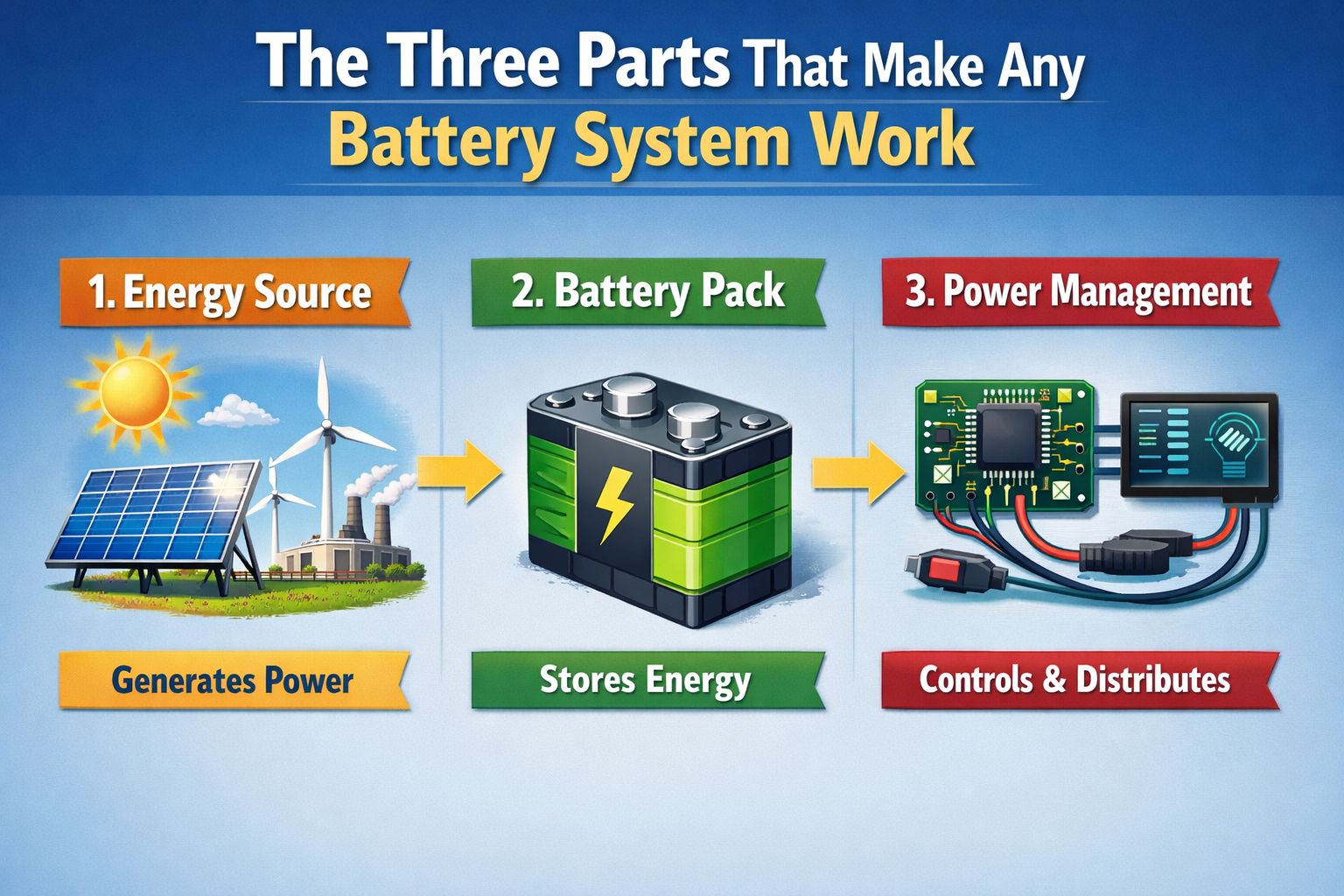
Regardless of which brand’s name is on the outside of the box, every home battery storage system relies on the same three core components working together. Understanding these parts helps you evaluate any battery system on its actual merits rather than just marketing claims.
Battery Management System: Your Pack’s Safety Net
The battery management system (BMS) monitors individual cells within the battery pack, preventing overcharging, overheating, and uneven cell degradation. This component is largely responsible for why modern LiFePO4 batteries require so little manual maintenance—it’s doing the safety work automatically, around the clock.
Inverters: Turning Stored DC Into Usable AC Power
Batteries store energy as direct current (DC), but your home’s appliances and the electrical grid run on alternating current (AC). The inverter handles that conversion, and its efficiency directly affects how much of your stored energy actually makes it to your outlets versus getting lost in the process.
Charge Controllers: Stopping Overcharge Before It Starts
Charge controllers regulate the flow of electricity from your solar panels into the battery, preventing overcharging that could otherwise shorten the battery’s lifespan. Think of it as a traffic cop for your energy system, making sure power flows in at a safe, controlled rate.
What the Numbers Tell You About Choosing a Storage System
When you line up the actual data—cycle life, depth of discharge, levelized cost per kWh, and real-world grid earnings—the choice of battery storage matters far more than which panel brand is on your roof. First Solar and SunPower serve different markets entirely, so the real decision comes down to which battery technology and which storage provider fit your home’s energy goals and your local utility’s rate structure.
Frequently Asked Questions
Does First Solar Make Home Battery Storage Systems?
No. First Solar manufactures utility-scale thin-film solar panels for large commercial and grid-scale installations, not residential battery storage products.
Is SunPower’s Battery Storage Better Than Tesla Powerwall?
SunPower doesn’t manufacture its own battery—it partners with storage providers—so comparing it directly to Tesla’s Powerwall Plus (13.5 kWh usable capacity) means comparing SunPower’s storage partner’s specific product rather than a SunPower-branded battery.
How Long Do LiFePO4 Batteries Actually Last?
LiFePO4 batteries typically last 5 to 10 years in real-world use, supported by a cycle life of 6,000 to 8,000 charge-discharge cycles. For those interested in understanding more about battery storage systems, this information is crucial.
Can I Make Money Selling Stored Solar Power Back to the Grid?
Yes, in markets with time-of-use pricing or feed-in tariffs—California homeowners, for example, can profit around $0.28/kWh by charging off-peak at $0.26/kWh and selling at $0.66/kWh during peak hours.
What’s the Real Payback Period for a Solar Battery System?
Payback period depends on your local electricity rates, system size, and usage patterns, but the levelized cost of storage—around $0.123/kWh for a standard LiFePO4 battery—gives you a solid baseline for calculating your own numbers.
Whichever panel brand ends up on your roof, pairing it with the right battery storage system is what actually determines your long-term savings, and Totlpower continues building all-in-one storage solutions designed to make that pairing simpler for homeowners.
The Three Parts That Make Any Battery System Work
Regardless of which brand’s name is on the outside of the box, every home battery storage system relies on the same three core components working together. Understanding these parts helps you evaluate any battery system on its actual merits rather than just marketing claims, whether you’re looking at a Tesla Powerwall Plus or a lesser-known alternative. For a deeper understanding of how these systems contribute to building a sustainable future, it’s essential to consider their efficiency and integration capabilities.
These three pieces—the battery management system, the inverter, and the charge controller—determine how safely your battery charges, how efficiently it delivers power, and how long it ultimately lasts. Skimp on any one of them and the whole system suffers, no matter how good the battery cells themselves are.
Battery Management System: Your Pack’s Safety Net
The battery management system (BMS) monitors individual cells within the battery pack, preventing overcharging, overheating, and uneven cell degradation. This component is largely responsible for why modern LiFePO4 batteries require so little manual maintenance—it’s doing the safety work automatically, around the clock, without you ever having to check a single cell by hand.
A well-designed BMS also balances charge across all the cells in the pack, which directly extends the battery’s usable cycle life. Without this balancing act, some cells would wear out faster than others, dragging down the entire pack’s performance years before it should fail. For more information on how battery storage systems play a crucial role in modern energy, you can read about battery storage systems.
Inverters: Turning Stored DC Into Usable AC Power
Batteries store energy as direct current (DC), but your home’s appliances and the electrical grid run on alternating current (AC). The inverter handles that conversion, and its efficiency directly affects how much of your stored energy actually makes it to your outlets versus getting lost in the process as heat. For more insights on sustainable energy solutions, consider exploring building a sustainable future.
Not all inverters perform equally here. A high-quality inverter minimizes conversion loss, which matters most during peak usage hours when you’re pulling the most power from your battery at once. To learn more about innovative solutions in energy management, explore carbon capture technology.
Charge Controllers: Stopping Overcharge Before It Starts
Charge controllers regulate the flow of electricity from your solar panels into the battery, preventing overcharging that could otherwise shorten the battery’s lifespan. Think of it as a traffic cop for your energy system, making sure power flows in at a safe, controlled rate no matter how much sunlight your panels are soaking up that afternoon.
Without a properly functioning charge controller, even a premium LiFePO4 battery can degrade faster than its rated cycle life suggests. It’s a small, often overlooked component that plays an outsized role in protecting your investment.
What the Numbers Tell You About Choosing a Storage System
- LiFePO4 batteries offer 6,000 to 8,000 cycles compared to just a few hundred for lead-acid alternatives
- A 100 Ah 12V battery delivers 1.2 kWh of capacity at a levelized storage cost near $0.123/kWh
- Depth of discharge of 80-90% means you’re actually using nearly all the capacity you paid for
- Annual maintenance costs around $10, making LiFePO4 nearly hands-off once installed
- Tesla’s Powerwall Plus delivers 13.5 kWh usable capacity, roughly 11 times a single 100 Ah unit
When you line up the actual data—cycle life, depth of discharge, levelized cost per kWh, and real-world grid earnings—the choice of battery storage matters far more than which panel brand is on your roof. First Solar and SunPower serve entirely different markets, so the real decision comes down to which battery technology and which storage provider fit your home’s energy goals.
Price shouldn’t be the only factor either. A cheaper battery with a shorter cycle life and lower depth of discharge can end up costing more per kWh over its lifetime than a pricier option built with higher-purity materials and a smarter BMS.
At the end of the day, the smartest approach is comparing the levelized cost of storage across your shortlist rather than just the sticker price. That single number accounts for lifespan, usable capacity, and purchase cost all at once, giving you a much clearer picture of real value.
Frequently Asked Questions
Solar storage questions tend to circle back to the same handful of concerns: lifespan, cost, brand comparisons, and whether you can actually profit from the system. Here are straightforward answers to the ones that come up most often.
If you’ve read this far, you likely already have a good sense of how the pieces fit together—these FAQs just fill in the remaining gaps.
Does First Solar Make Home Battery Storage Systems?
No. First Solar manufactures utility-scale thin-film solar panels for large commercial and grid-scale installations, not residential battery storage products. For more information on sustainable energy solutions, consider exploring how companies are building a sustainable future.
Is SunPower’s Battery Storage Better Than Tesla Powerwall?
SunPower doesn’t manufacture its own battery—it partners with storage providers—so comparing it directly to Tesla’s Powerwall Plus (13.5 kWh usable capacity) really means comparing SunPower’s storage partner’s specific product rather than a SunPower-branded battery.
How Long Do LiFePO4 Batteries Actually Last?
LiFePO4 batteries typically last 5 to 10 years in real-world use, supported by a cycle life of 6,000 to 8,000 charge-discharge cycles depending on how heavily the system is used.
Can I Make Money Selling Stored Solar Power Back to the Grid?
Yes, in markets with time-of-use pricing or feed-in tariffs. California homeowners, for example, can profit around $0.28/kWh by charging off-peak at $0.26/kWh and selling it back at $0.66/kWh during peak hours through net-metering.
Results vary significantly by location, since not every utility offers the same rate spread. Checking your local time-of-use schedule before investing in a battery sized for grid-selling is a smart first step. For more insights on sustainable energy practices, you can explore how companies are setting carbon emission reduction targets.
What’s the Real Payback Period for a Solar Battery System?
Payback period depends on your local electricity rates, system size, and usage patterns, but the levelized cost of storage—around $0.123/kWh for a standard LiFePO4 battery—gives you a solid baseline for calculating your own numbers.
Homeowners in high-rate areas with strong peak-to-off-peak spreads, like California or parts of the UK, tend to see faster payback than those in regions with flatter utility pricing. Run your own numbers using your actual utility rate before assuming a specific timeline.
Whichever panel brand ends up on your roof, pairing it with the right battery storage system is what actually determines your long-term savings, and Totlpower continues building all-in-one storage solutions designed to make that pairing simpler for homeowners.
As more companies strive to reduce their carbon footprint, the importance of embracing sustainability becomes increasingly evident. This path not only helps in achieving net-zero goals but also ensures a sustainable future for the coming generations. Businesses are now more focused on integrating sustainable practices into their operations, recognizing the long-term benefits of environmental responsibility.
RELATED POSTS
View all


Carbon Offsets vs. Carbon Credits: Key Differences, Quality & Corporate Procurement Guide
November 7, 2026 | by Steve Last
 Photo by Marina Lakotka on Unsplash
The Path to a Sustainable Future: Setting Carbon Emission Reduction Targets for Net-Zero 2050
August 5, 2023 | by Steve Last

How to Align Your ESG Strategy with Global Sustainability Goals
August 19, 2024 | by Steve Last